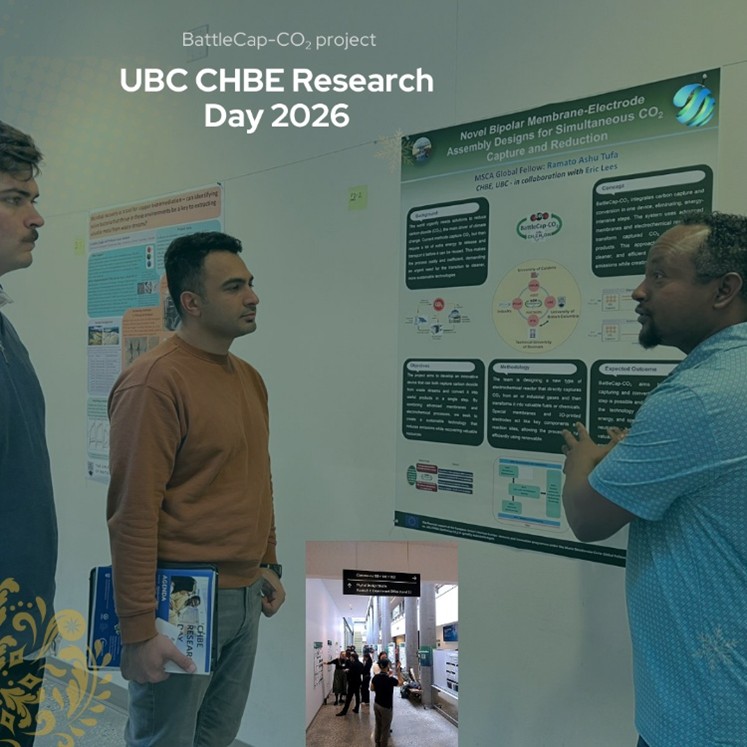
BattleCap-CO2 was showcased at the CHBE Research Day 2026 held on 19 February 2026 at the University of British Columbia, where great discussions were held with faculty, researchers, and students on carbon capture and electrochemical innovation.
The event brought together the CHBE community to exchange ideas, highlight ongoing research, and foster new collaborations in sustainable energy and clean technology.
The BattleCap-CO₂ Fellow, Dr. Ramato Ashu Tufa, attended the CHBE Special Seminar at the University of British Columbia featuring Prof. Koyo Norinaga (Nagoya University).
Seminar Title
“R&D of a New DAC Technology Using LNG Cold Toward Demonstration”
During the seminar, Prof. Norinaga presented Cryo-DAC®, an innovative direct air capture (DAC) technology that utilizes the cold exergy available during LNG regasification to enable energy-efficient CO₂ separation from air. The project is being developed through a strong academia–industry consortium involving gas utilities, EPC contractors, and materials manufacturers to accelerate technology validation and scale-up.
The talk highlighted recent progress in concept validation, operation of a bench-scale plant, and development of advanced CO₂ absorbents. The seminar provided valuable insights into emerging DAC pathways, complementing the BattleCap-CO₂ mission of advancing integrated and energy-efficient carbon capture technologies.
We are pleased to highlight the upcoming AMSIC Academy Webinar organized by the African Membrane Society (AMSIC), featuring Prof. Frank Lipnizki, President of the European Membrane Society (EMS) and Professor at Lund University, Sweden.
With extensive academic and industrial experience in membrane technology for water, wastewater, and industrial applications, Prof. Lipnizki is a leading authority in advancing membrane solutions for sustainable resource management.
Webinar Title: “Advances in Membrane Technology for the Water-Food-Energy Nexus” The webinar will present recent research advances in optimized membrane processes for plant protein extraction, lignin recovery in biorefineries, renewable-energy-driven desalination with zero liquid discharge, and membrane fouling and cleaning. These innovations contribute to resource efficiency, circular economy principles, and sustainable development across the water–food–energy sectors.
The journey of the Fellow, Dr. Ramato Ashu Tufa, began by attending the 2025 Pacific Coast Catalysis Society (PCCS) Meeting at The University of British Columbia (UBC) on his very first day of arrival in Canada as a Marie Skłodowska-Curie Global Fellow.
Hosted at UBC’s Chemical & Biological Engineering Building, the symposium brought together leading experts in thermochemical and electrochemical catalysis, as well as advanced modeling approaches. Researchers from institutions including Stanford, Ohio State, UW, UBC, and others shared cutting-edge insights into catalytic materials and electrochemical systems.
This timely participation provided an excellent opportunity for Dr. Tufa to introduce and exchange ideas related to the BattleCap-CO₂ project, particularly its vision of integrating CO₂ capture and electrochemical conversion within a single intensified reactor system. Engaging with researchers across catalysis, materials science, and electrochemical engineering, he strengthened international collaboration at the very start of the outgoing phase of the fellowship.
The event marked a dynamic and inspiring beginning to the MSCA Global Fellowship at UBC. Special appreciation goes to Prof. Eric Lees and Prof. David Chester Upham for organizing such a stimulating scientific forum.
BattleCapCO2 - All images belong to their respective owners - Designed by Fabio Ferraro