BattleCap-CO₂ is funded by the prestigious Marie Skłodowska-Curie Actions (MSCA) Global Fellowship and aims to transform how carbon dioxide (CO₂) is captured and converted.
The project develops a novel electrochemical reactor that directly integrates CO₂ capture and conversion into a single, intensified system — eliminating energy-intensive intermediate steps such as CO₂ release, purification, compression, and transport. By advancing next-generation bipolar membranes (BPMs) and bio-inspired 3D-engineered electrodes, BattleCap-CO₂ enables the efficient transformation of captured CO₂ into valuable products such as ethanol using renewable electricity.
This integrated membrane–electrode assembly approach addresses key scientific and technological barriers in traditional carbon capture and utilization (CCU) systems, reducing energy demand while improving scalability and performance. The concept promotes a circular carbon pathway, where emissions are converted into resources rather than released into the atmosphere.
The project is implemented across leading international institutions:
- 2 years at the University of British Columbia (Canada)
- 1 year at the University of Calabria (Italy)
- A 3-month industrial placement at PCCell GmbH (Germany) focused on reactor design and scale-up
Aligned with the European Green Deal and global climate neutrality goals, BattleCap-CO₂ bridges materials science, electrochemistry, and engineering to accelerate the deployment of sustainable carbon technologies. By connecting fundamental research with industrial application, the project contributes to a future where carbon is not a waste product - but a valuable resource.
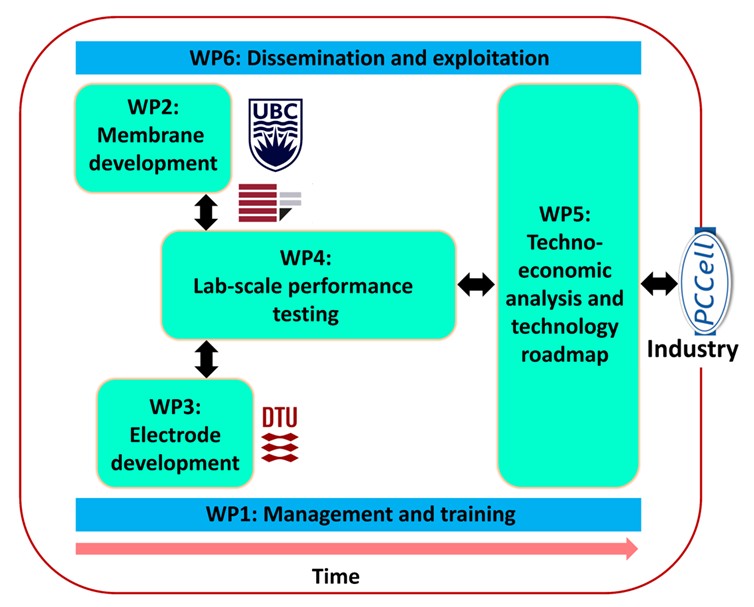
BattleCap-CO₂ brings together academic and industrial partners from Europe and North America in a coordinated international effort to advance integrated CO₂ capture and conversion technologies. Through a series of interconnected research and innovation activities, the project moves from advanced material development to system validation and industrial assessment, ensuring that scientific breakthroughs translate into practical, scalable solutions. By combining expertise in membrane science, electrochemical engineering, reactor design, and techno-economic evaluation, the consortium works collectively toward transforming CO₂ emissions into valuable resources and accelerating the transition to climate neutrality.
The BattleCap-CO₂ project is coordinated by the University of Calabria and implemented within the research group led by Prof. Efrem Curcio at the Department of Environmental Engineering. The group has internationally recognized expertise in advanced membrane materials and process engineering, covering thermal- and pressure-driven membrane operations (e.g., membrane distillation and filtration) as well as electro-driven membrane technologies, including electrodialysis and membrane-based electrochemical systems for sustainable separation and energy applications.